
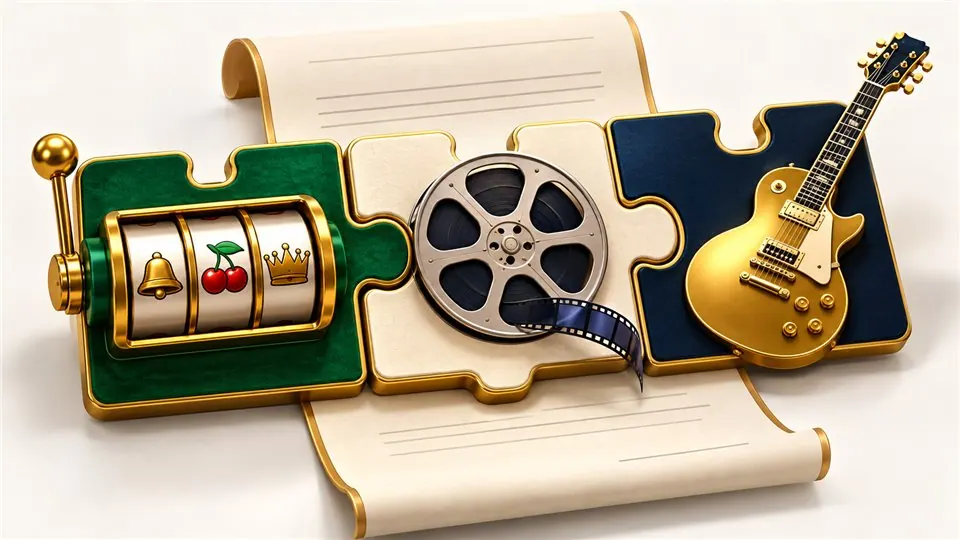
Branded slots licensing can involve separate rights for names, music, artwork and software. A product announcement may confirm a collaboration without disclosing its fees or territorial terms. Verify which assets and title the public record actually covers. This is an evidence-reading guide, not legal advice.
Copyright and trademarks do different work
WIPO’s copyright overview identifies protected expressive works, including music, films, artwork and software, while distinguishing them from ideas and mathematical concepts as such. The USPTO’s explanation describes trademarks as source-identifying signs.
A slot can therefore require attention to several separate assets. Permission to use a name does not automatically establish permission to use a particular recording, photograph or likeness.
Look for evidence of an actual arrangement
WMS’s 2004 annual filing identifies a September 1997 licence agreement with Hasbro and subsequent amendments. It is a concrete historical document, not merely evidence that the two brands appeared together.
Some portions were subject to confidential treatment. An editor should not invent fee amounts, approval rights or territorial terms that the public document does not disclose.
A product announcement can confirm a collaboration
NetEnt’s 21 January 2016 Guns N’ Roses announcement describes its branded production and use of the band’s music. That is attributable evidence of the announced product, not an independent inspection of every licence clause.
A historical announcement also does not establish that the same product is available today in every territory. Current access and continuing rights require their own evidence.
Scope matters more than the word licensed
A rights agreement can define permitted media, territories, duration, assets and uses. The details depend on the agreement and applicable law. A public press release may reveal only some of them.
For a review, the correct question is which product and assets the available statement actually covers. Do not generalize a permission for one title to every later sequel or similar-looking reskin.
A familiar theme is not always a licensed brand
Generic mythology, fruit symbols or an original rock-band character do not establish a relationship with a named entertainment property. Likewise, a character’s resemblance alone is not enough for Lupita to claim an infringement.
Use a branded-slot label when credible product-specific attribution supports it. Otherwise describe the theme without inventing a commercial connection.
Supplier rights do not automatically transfer to a demo site
A studio’s permission to include an asset in its slot does not necessarily grant a separate website permission to reproduce every promotional file, remove credits or sell access. Public availability is not a blanket rights licence.
Lupita’s editorial illustrations avoid copying branded characters and are labeled as conceptual. Provider screenshots remain distinct from those illustrations, and neither category should be passed off as proof of a licensing contract.
Sources and review notes
Editorially reviewed 2026-10-08. Regulatory references apply within their stated jurisdictions, not to every demo or country. Practical examples are explanatory, not provider certification or predictions of future results.
Continue reading
Same Slot, Different Names? Compare Identity, Not Artwork
Use provider identity and documented rules to distinguish a translated title, seasonal edition and sequel before merging slot pages or borrowing specifications.
Slot Studio vs Aggregator: Identify Who Makes and Delivers It
Trace the roles of developer, publisher, aggregation service and operator so a launcher domain is not mistaken for the slot’s creator.

Verify Slot Release Claims: A Provider Press-Release Checklist
Extract useful release facts without copying promotional conclusions, confusing announcement dates with launches or presenting supplier payout reports as independent records.