
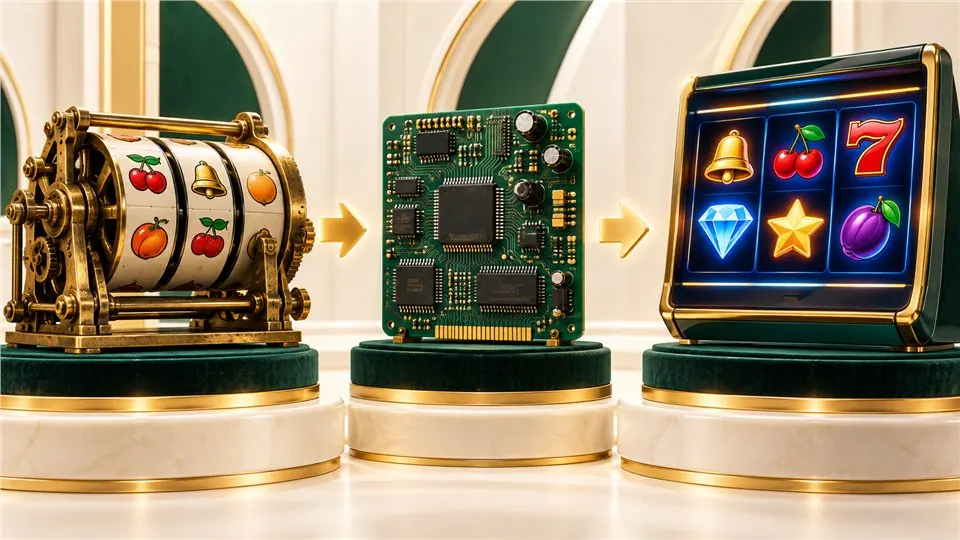
Slot history did not make one clean jump from a lever to a browser. Payout hardware, result selection and visual presentation changed on different timelines. A machine could retain physical reels while introducing electronic control.
Separating those layers makes the transition easier to understand and prevents a familiar-looking reel window being mistaken for proof of a mechanical selection process.
Mechanical cabinets linked moving parts to awards
In a mechanical arrangement, the relevant moving parts and payout mechanism belong to a physical cabinet. The details differ by design; the lever's existence alone does not establish all its probabilities.
A surviving object's maker, mechanism and schedule are the starting evidence. Do not calculate every historical slot from a generic drawing of three equally sized reels.
Electromechanical payout changed what the cabinet could handle
The Irving Kaye historical archive dates Bally's Money Honey debut to November 1963 and describes electronically controlled construction and a motor-driven payout hopper. This is a documented account from an archive associated with a participant in Bally's history.
The important distinction is that electrical assistance to handling or payout is not synonymous with replacing the reel display with video. “Electronic slot” is too vague to identify which layer changed.
Electronic mapping loosened the physical-strip constraint
Telnaes's 1984 patent documents a selection range larger than the physical set of reel positions. That mapping can produce unequal displayed-stop probabilities without adding the same number of physical stops.
This layer concerns selecting and representing outcomes. It can be explained independently of whether the visible result appears on a cylinder or a screen.
Video separates symbols from a fixed physical window
A screen can display changing layouts, secondary scenes and overlays without constructing another mechanical assembly for each visual state. That is a design possibility, not a claim that every video slot includes every such feature.
Once presentation becomes software-driven, a reel image can preserve the visual language of a cabinet while using a different selection model. The animation is no longer a useful mechanical inspection by itself.
These transitions overlapped rather than deleting one another
Physical reels and video formats can coexist in later product ranges. A branded cabinet may use a physical base display with a separate bonus presentation. An online title can imitate mechanical simplicity for stylistic reasons.
Describe the specific product rather than treating “old” and “new” as mathematical categories. A date or screen type does not establish RTP, volatility or fairness.
Browser delivery introduced another layer
A browser launcher adds asset loading, network services and device controls to the experience. Those delivery details are not the same question as how an outcome is selected.
Continue with online slot history and virtual reels. The useful timeline follows documented changes in layers rather than a claim that a more modern screen offers better odds.
Sources and review notes
Source-checked 2026-10-07. Regulatory references apply within their stated jurisdictions, not to every demo or country. Practical examples are explanatory, not provider certification or predictions of future results.
Continue reading

Virtual Reels Explained: The Selection Behind the Reel Window
Understand virtual reel mapping, its documented history and why the number of visible stops does not necessarily determine a slot’s probabilities.

Online Slot History: From Casino Software to Browser-Based Demos
Follow documented software milestones, browser migration and distribution changes without confusing a company’s first-product claim with the first slot ever.

Bonus Round History: How a Secondary Scene Became Part of the Slot
Explore documented secondary-bonus design, the move from separate scenes to persistent reel features and why an interactive choice need not imply skill.