
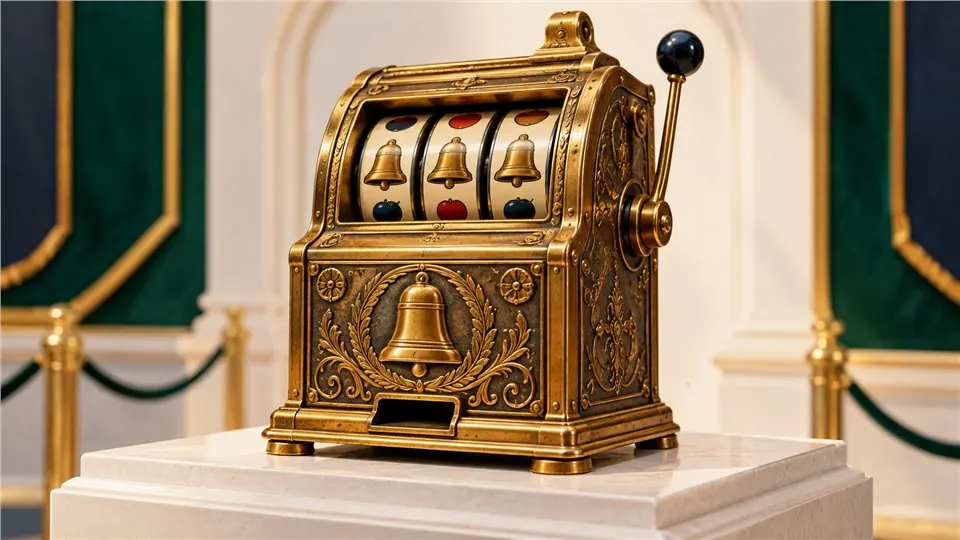
The Liberty Bell is important because of a particular combination of design ideas, not because it was the first object ever to accept a coin for a chance of a prize. Earlier gambling and trade-stimulator devices already existed.
Charles Fey's machine helped establish the automatic-payout, three-reel format. The chronology needs care: official records do not all assign it the same year.
1895 and 1898 appear in authoritative records
California's landmark listing, number 937, attributes the invention of the three-reel bell machine to Fey in 1895. SFO Museum's exhibition catalogue dates its Liberty Bell exhibit and accompanying account to 1898.
These are distinct records. A surviving object's date, a prototype's date and a retrospective invention date need not refer to exactly the same event. This article preserves the discrepancy rather than claiming to resolve it from a repeated web anecdote.
“First slot machine” is too broad without a definition
A coin drop, an exposed wheel and a card-based trade stimulator can all be part of early machine-gambling history. Calling the Liberty Bell the first gambling machine erases those predecessors.
A more useful description specifies the three reels and automatic payout. That identifies the innovation under discussion and avoids competing “first” claims that are actually about different device categories.
Automatic payout changed the transaction
With an attendant-awarded prize, the displayed result still needs a person to interpret and fulfil it. An automatic mechanism links the qualifying combination to the payout process inside the cabinet.
That is an engineering distinction, not a guarantee of fairness or profitability. To evaluate any historical cabinet, its particular mechanism and payout schedule still matter.
A recognizable display helped the format endure
Three symbol windows make a combination legible without showing the entire selection structure. A bell is also an immediately recognizable emblem. Together they create a visual language that later slot designs can reuse even when the hardware changes.
The enduring appearance should not be confused with identical mathematics. A modern three-reel-looking screen can operate through software rather than the mechanical arrangement of a museum object.
How to read an artifact record
Look for maker, date, materials, lender or collection and an object identifier. Those details distinguish a documented exhibit from a generic image caption copied between websites.
Do not use a newly generated illustration as evidence of the original machine's exact casting, symbol strip or paytable. Our cover is explicitly conceptual; the museum link supplies the historical reference.
What the Liberty Bell explains about modern demos
The familiar reels are a presentation convention that outlived their original mechanism. Later changes include electronic selection, video displays and browser delivery, each with its own documentary record.
Continue with Fey's workshop and early devices and the transition to electronic and video slots. Historical continuity is useful context, not a method for predicting current rounds.
Sources and review notes
Source-checked 2026-10-07. The 1895/1898 discrepancy is deliberately disclosed. The cover is not a photograph or an exact reconstruction of a documented artifact.
Continue reading
Charles Fey’s Workshop: Early Slots Were More Than the Liberty Bell
Follow Fey’s San Francisco workshop, his collaboration with Theodore Holtz and the varied devices that preceded the familiar three-reel slot format.

Why Slots Use Fruit Symbols: Gum, Trade Stimulation and a Lasting Visual Code
Explore the historical link between fruit symbols and gum vending, the BAR emblem and why modern fruit imagery does not reveal a slot’s rules.
From Mechanical Reels to Video Slots: Three Changes Often Confused
Separate motor-driven payout, electronic outcome selection and video presentation. Understand why a screen change does not by itself describe the mathematics.