
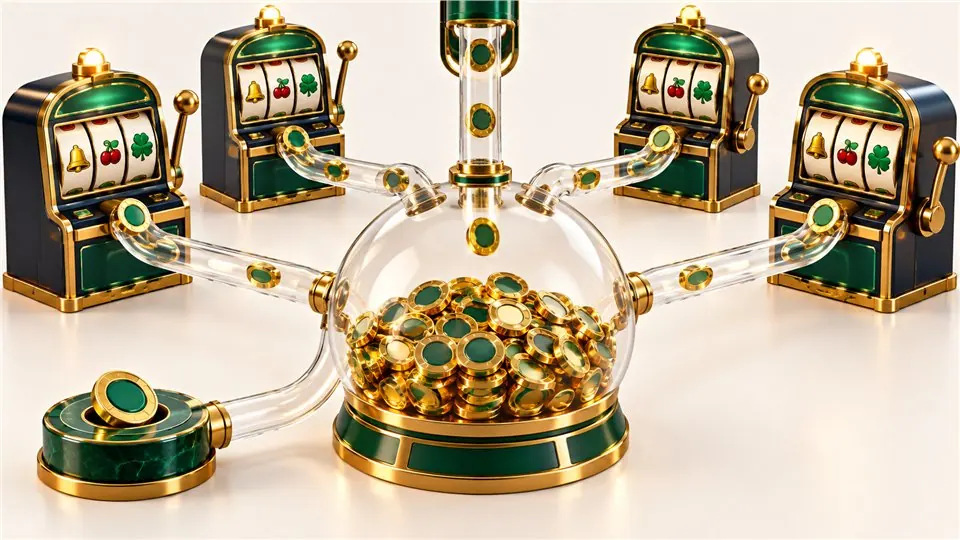
A progressive jackpot grows according to a defined funding system rather than remaining at a fixed prize value. The important evidence is its pool rules: what contributes, who qualifies, how an award is determined and what happens afterward.
A large meter, the word Grand or an animated pot is not enough to establish those rules.
The pool has a funding rule
Consider a fictional system seeded with 1,000 units and adding 0.01 units from each qualifying round. After 500 such contributions, it would reach 1,005 units if there were no awards, caps or other changes.
The example explains growth only. Real contribution formulas, additional funding and eligibility conditions must be documented. A demo counter does not prove it participates in a live paid pool.
Progressive does not always mean a global network
A growing prize can be associated with one product or a linked set of participants. The word progressive alone does not identify the size, reach or ownership of that network.
Ask which products share the displayed pool and whether the value shown is current. A very large network claim should be sourced rather than inferred from a rapidly changing counter.
Growth and winning conditions are different questions
The funding method explains how the pool increases. The award rule explains how an eligible player can receive it. One cannot be derived from the other.
Do not assume that a high displayed amount is statistically overdue. If the rules use a must-award threshold or another distinct trigger system, explain that specific system; otherwise a rising balance is not evidence of a pending result.
A useful regulatory example lists the missing questions
Britain’s RTS 9 addresses funding, seed and ceiling values, eligibility and jackpot information within its scope. It also covers practical matters such as how apparently simultaneous triggers are handled.
That framework helps an editor ask better questions. It does not prove that an international demo display is connected to a compliant paid network.
Check what follows an award or ceiling
A paid jackpot can return to a defined reset value after an award. If a ceiling is reached, contributions may be handled according to another published rule. Neither process should be guessed from the animation.
A demo reset can simply restart a simulation. It should not be presented as evidence that a paid jackpot was won elsewhere.
Classify evidence, not promotional language
A catalogue should distinguish a supplier’s progressive label from independently inspected pool rules. If only the label is available, say which evidence remains missing.
For a deeper funding explanation, read how progressive jackpots grow. For an individual demo, remember that every displayed award remains non-redeemable regardless of the advertised pool size.
Sources and review notes
Source-checked 2026-10-07. The contribution calculation is fictional. Lupita has not independently inspected every provider’s live jackpot network, and demo counters are not evidence of participation in a paid pool.
Continue reading

How Progressive Jackpots Grow: Contributions, Seeds and Resets
Follow a fictional progressive pool from its starting value through eligible contributions and a reset. Separate prize growth from trigger probability and demo displays.

Progressive Jackpot History: From a Local Prize to a Networked Pool
Trace the significance of IGT’s 1986 Megabucks system, distinguish local and wide-area networks and understand why historic award terms matter.

Fixed Slot Jackpots: A Named Prize Without a Growing Shared Pool
Compare fixed prize tiers with progressive pools, including why a stake-scaled jackpot can change amount without becoming progressive.