
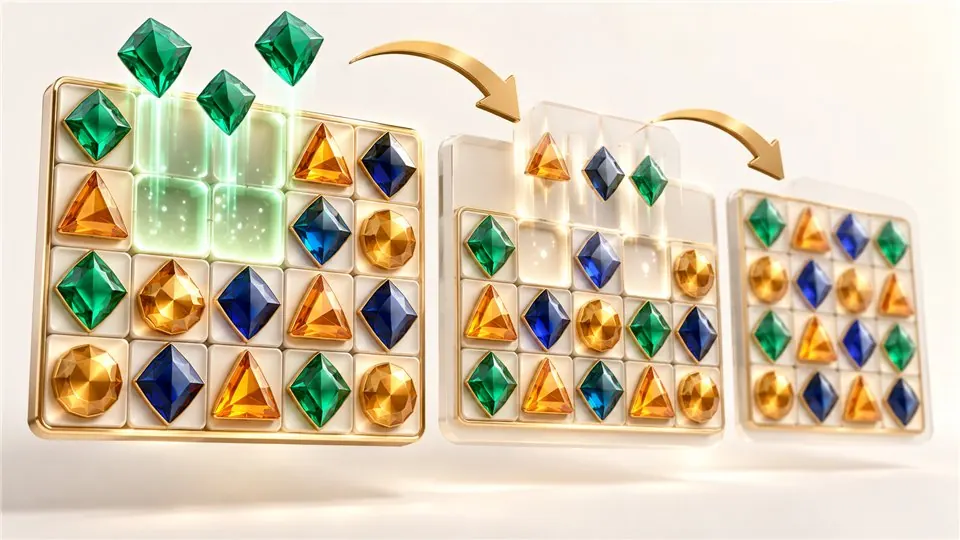
A cascading-reels round can contain several evaluations but only one initial stake. Sum the included awards, then compare that total with the stake to find the net result. Replacement symbols and changing multipliers do not automatically create new paid rounds.
Trace one complete fictional round
Imagine a fictional one-credit round. Its first evaluation awards 0.30 credits; the qualifying symbols clear. The replacement grid awards 0.50, clears again, then produces no further qualifying combination.
The combined award is 0.80 credits and the net round result is minus 0.20. Two awards did not create two profitable rounds. The original stake remains the basis unless the rules explicitly describe another commitment.
Replacement does not guarantee another award
A new grid can qualify again or end the sequence. A symbol falling near a promising group does not mean the cascade owes the player a continuation.
The supplier’s rules define which positions clear, how replacements arrive and any special symbols that persist. Do not assume every symbol disappears, every refill is identical or the visible animation reveals the underlying probability mapping.
Track multiplier state precisely
A product may increase a multiplier across a chain, retain some state during a feature or reset it at the next base round. These details are title-specific.
For example, 101 Candies documents a Wild Conveyor associated with Avalanche drops and describes different reset behavior in base play and free spins. That is a specific implementation, not a rule for every cascading slot.
A longer chain can still reach a defined ceiling
Repeated evaluations do not automatically bypass a round cap. If the published maximum covers the complete round, all included awards need to be interpreted within that rule.
Check whether reaching a cap terminates further stages or limits the final total. A review that lists only “unlimited cascades” without the cap conditions may leave a misleading impression.
Do not inflate the number of paid events
A demo log should distinguish the initial round, each subsequent evaluation and the final award. Counting every drop as a separate “spin” can distort a hit-rate or session description.
Likewise, a long feature clip contains more screen time but does not reveal how often comparable chains occur across all rounds. Highlights demonstrate appearance, not a representative distribution.
Watch the final round total
Follow the stake once, note any changing multiplier, and wait for the completed result. If the total is unclear, that is a usability issue worth recording.
A cascade is an interesting way to structure a round, not a technique the visitor can steer into profitability. Related cascading demos should be compared by documented rules and readable presentation.
Sources and review notes
Editorially reviewed 2026-10-08. All credit awards in the worked round are fictional. They are not results from 101 Candies or a forecast for a demo session.
Explore the slot and related demos
Catalogue pages with provider sources and available embedded demos. Related titles share catalogue mechanics or themes; this is not a payout ranking.


Continue reading

Cluster Pays vs Paylines: Compare the Same Grid Two Ways
Compare connected groups with line patterns using a fictional grid, and see why visual complexity does not establish higher RTP or more profitable rounds.

Slot Maximum Wins and Caps: Read the Limit Behind the Headline
Distinguish a maximum multiplier, a round cap, a progressive prize and promotional cashout terms. Calculate a fictional cap using the correct stake unit.

RTP vs Hit Rate: A Slot Can Pay Often and Still Return Less
Compare award frequency with expected return using two fictional slots. Understand small payouts, net wins and why frequent celebrations can mislead.