
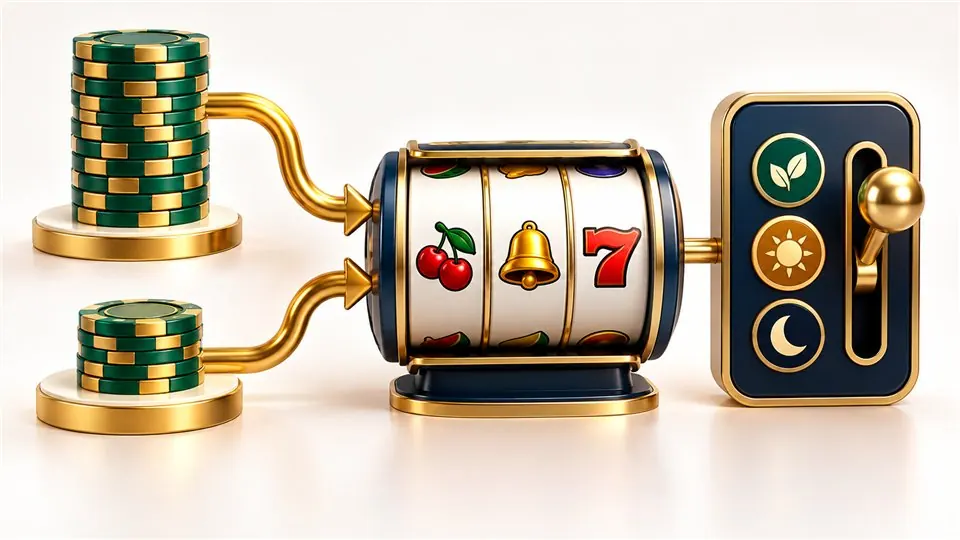
A larger stake can produce a larger monetary award without increasing the probability of that award. The key is whether only the stake scales or whether the selected mode actually changes the rules.
The answer belongs to the loaded slot's information panel. Neither “bigger bets always improve odds” nor “stakes can never affect any rule” is a safe universal description.
Scaling money is different from changing probability
Assume a fictional model where an event has a fixed 5% chance and pays ten times total stake. At one credit, that award is ten credits. At two credits, it is 20. The event chance remains 5% under the assumption.
The larger result does not make the second stake mathematically twice as likely to qualify. It doubles the amount committed and the proportional award.
A separate option may select a different model
A slot can offer a documented volatility choice, enhanced mode or other alternative rules. BGaming's Diamond of Jungle announcement documents a selectable volatility design.
That example demonstrates an explicit product option, not a rule that increasing any ordinary stake changes volatility. Read exactly what the selected control changes.
Jackpot eligibility can have its own conditions
A jackpot may require a particular stake or qualifying mode. If the rules state such a condition, changing eligibility is different from merely changing a base award amount.
Do not import a historic cabinet's maximum-coin requirement into an unrelated online slot. Verify the current launch and the specific jackpot tier.
A feature purchase is not just a bigger ordinary spin
Paying a feature-entry price can select a different starting state rather than repeat the base round at a larger unit. Its cost and return disclosure need to be evaluated on their own terms.
A purchase at 100 times ordinary stake is not a one-stake decision. A maximum expressed in ordinary-stake multiples also needs that denominator attached.
Compare the same title, configuration and mode
Record the two settings, their stated prices, rules and RTP disclosures. If the information panel provides no probability difference, do not invent one from a favourable short sequence at the larger stake.
Different operator launches can introduce another configuration difference. Comparing their results without identifying that difference is not a clean test of stake size.
Do not raise stakes to fix a streak
Previous losses do not establish that a larger stake is now more likely to recover them. A mode change can increase cost even where its rules alter some event frequency.
See mode-aware comparisons and loss chasing. This page explains conditional cases, not a recommendation to increase spending.
Sources and review notes
Source-checked 2026-10-07. The 5% model is invented and assumes unchanged probabilities with proportional awards. Actual alternative modes and jackpot eligibility require their own rules.
Continue reading

Compare Slot RTP and Volatility Without Inventing a Winning System
Build a useful comparison of return, award spread, feature costs and evidence quality. Learn why neither high RTP nor low volatility promises a result.

Slot Jackpot Probability: Rare Does Not Mean Overdue
Distinguish jackpot value, eligibility and event probability. A fictional calculation explains average waiting times without promising a win after enough spins.

Why Chasing Slot Losses Does Not Create a Recovery Advantage
See why raising stakes after a loss increases exposure rather than making repayment more likely, and why a doubling system can fail abruptly.