
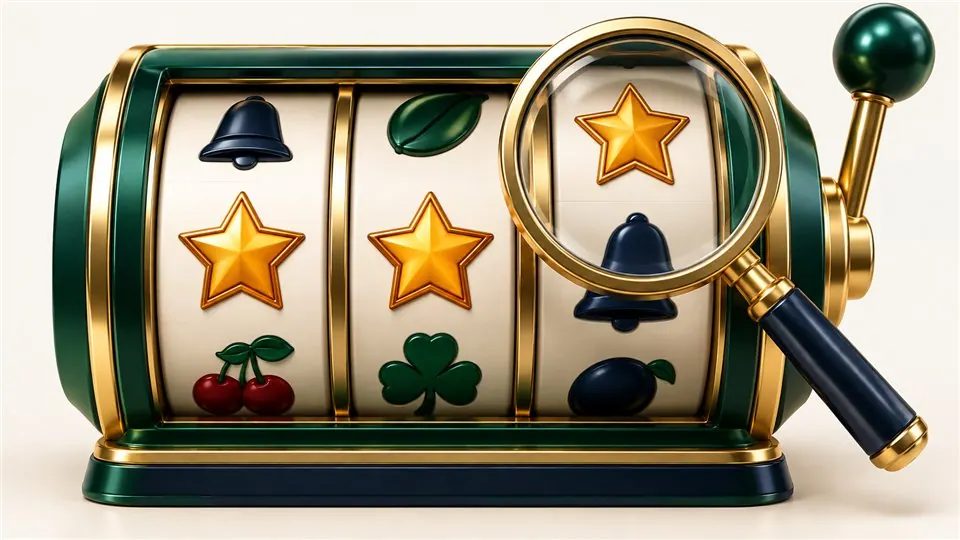
Two matching symbols land on the line and a third stops just above it. The display looks close to a win, but the paytable still evaluates a losing combination. That kind of visually close unsuccessful outcome is commonly called a near miss.
The word “near” describes the presentation, not a partially earned jackpot or evidence that the next selection is improving. The distinction matters because the feeling of nearly succeeding can be more memorable than an ordinary miss.
Start with the positions that actually count
Check the rule before classifying an outcome. On a payline slot, a neighbouring symbol may not count. In a ways slot, an apparently broken visual line might still qualify. A scatter award may use symbols anywhere in the permitted area.
A near miss should therefore be described relative to a specific winning condition. Saying “three symbols were close together” is insufficient. Did they satisfy the rule, produce a smaller award or produce no award at all?
What a controlled study found
Clark and colleagues' 2009 study used a simplified slot task. Near misses were unpleasant but increased reported desire to continue in the condition where participants selected the play icon themselves. The response was different when the computer selected it.
That finding concerns the participants, task and conditions studied. It is not proof that every near miss has the same effect on everyone. Brain activity associated with an outcome also does not change the mathematical probability of the following round.
Why the display can encourage a misleading comparison
A visible near miss invites a counterfactual: “If that last symbol had moved one position, I would have won.” The statement about a different displayed outcome can be true while the conclusion “therefore I should keep playing” remains unsupported.
Compare that with an actual skill task. Missing a target by a small distance may help someone adjust an action. Ordinary random reel selection does not provide that same feedback loop. There is no demonstrated adjustment merely because a symbol appeared adjacent to the required position.
The next-round probability is a separate question
In a fictional independent model with a fixed 1% chance of an event on each round, a near miss does not increase the next-round chance to 2%. The displayed neighbours do not add a success to the model or remove a future failure.
If a published feature collects symbols or preserves progress, evaluate that actual state instead. A visible collection counter is a rule-defined state change. A player feeling closer after a miss is not one.
Natural presentation versus replacing an outcome
The UK Gambling Commission's RTS 7 prohibits substituting a different losing result to show a near miss. This does not mean every visually close losing layout is banned; a permitted selected result can itself look close.
That standard applies within its stated regulatory scope. An animation viewed in isolation cannot establish whether the underlying selection complied with it. Such a claim requires implementation and testing evidence.
A practical response to the feeling of “almost”
Read the awarded amount and the rule, not just the celebratory sound or position of a symbol. If “one more” starts to feel compulsory, close the demo and take a break. Virtual credits do not eliminate the time or attention spent.
For related questions, read near-miss myths and whether a slot can be due. This article explains an outcome and a research finding; it does not diagnose a reader or offer a winning tactic.
Sources and review notes
Source-checked 2026-10-07. The research concerns a controlled experimental task, not a universal response or a clinical assessment. The 1% probability example is fictional.
Continue reading

Near-Miss Myths: A Strong Reaction Does Not Mean Better Slot Odds
Separate proximity, emotion and probability. See why different near misses can produce different reactions and why “almost” does not certify skill or an overdue award.

Can a Slot Be Due to Pay? Losing Streaks Are Not a Countdown
Understand why independent slot rounds do not become overdue, how long-run averages differ from compensation and which published states need separate analysis.
Virtual Reels Explained: The Selection Behind the Reel Window
Understand virtual reel mapping, its documented history and why the number of visible stops does not necessarily determine a slot’s probabilities.

When to Stop a Slot Session: Use a Boundary, Not a Payout Signal
Choose stopping conditions unrelated to streaks, near misses or recovering a balance, and recognize when a complete break and support are needed.